
Main Content

Department of Bio Technology
Programmes Offered
- UG - B. Tech - Biotechnology
- PG - M. Tech - Biotechnology
Introduction
The world of biotechnology has revolutionized modern development by encompassing the fields of agriculture, industry, environment, and healthcare. To explore the potential of this sunrise technology, the seed was sown in the year 2002. The seedling germinated as Anna Bio Research Foundation and has been nurtured by dynamic and enthusiastic faculty members. The department offers undergraduate (B.Tech) and postgraduate (M.Tech) programs in Biotechnology affiliated with Anna University.
The undergraduate program, B.Tech in Biotechnology, was started in 2002 with an intake of 30 students, which was increased to 60 in 2005. So far, 300 students from seven batches have graduated from the department. Among them, more than 20% have secured admission for higher studies abroad. Graduates are pursuing advanced studies in prestigious institutions such as IITs and Anna University, and are employed in leading industries including Biocon and Reliance Life Sciences.
To nurture research activities and enhance skilled manpower in biotechnology, the department introduced the postgraduate program, M.Tech in Biotechnology, in 2012.
The department laboratories are equipped with high-end instruments for molecular biology, biochemistry, microbiology, bioprocess engineering, and downstream processing. These facilities provide students with strong analytical knowledge, hands-on experience, and essential soft skills. The department has been ranked among the top ten private institutions offering biotechnology programs in India.
The department is supported by highly enthusiastic and motivated faculty members who are actively involved in teaching, research, and innovation.
Vision
To transform the department into a center of excellence in Biotechnology education, research and training, to improvise the manpower in various fields of biotechnology to meet the increasing global demand.
Mission
- Train students to become competent biotechnologists capable of applying principles of life sciences and engineering to solve diverse problems in biotechnology.
- Enable graduates to develop strong foundational knowledge and innovative skills in plant and animal biotechnology, bioprocess engineering, environmental biotechnology, and biomolecular engineering.
- Prepare graduates to address real-world challenges in biotechnology through interdisciplinary learning, research, and industry-relevant applications.
Quality Policy
The department is enthusiastic in bringing out the hidden talents and to nurture their ideas by providing an incomparable platform to make them as successful biotechnologists, so that they can compete with others both in National and International context.
Programme's PEO's, PSO's and PO's
Program Educational Objectives (PEOs)
- PEO1: To prepare students as technologists in the relevant field, intensifying their inquisitiveness for successful careers in bio-based industries, meeting the needs of Indian and multinational companies, and developing socially responsible engineers capable of technology leadership.
- PEO2: To develop the ability among students to synthesize data and technical concepts for application to industrial-scale operations.
- PEO3: To provide opportunities for students to work effectively as part of teams on multidisciplinary projects.
- PEO4: To provide students with a strong foundation in mathematical, scientific, and engineering fundamentals to formulate, solve, and analyze biotechnological problems and prepare them for higher studies.
- PEO5: To promote awareness of lifelong learning and instill professional ethics and codes of professional practice.
Program Outcomes (POs)
- PO1 – Engineering Knowledge: Apply knowledge of mathematics, science, engineering fundamentals, and biotechnology specialization to solve complex engineering problems.
- PO2 – Problem Analysis: Identify, formulate, review research literature, and analyze complex engineering problems using principles of mathematics, natural sciences, and engineering sciences.
- PO3 – Design / Development of Solutions: Design solutions and biotechnological processes that meet specified needs with due consideration to public health, safety, societal, cultural, and environmental factors.
- PO4 – Conduct Investigations of Complex Problems: Use research-based knowledge and methodologies including experimental design, data analysis, interpretation, and synthesis to derive valid conclusions.
- PO5 – Modern Tool Usage: Create, select, and apply appropriate modern engineering and IT tools, including modeling and prediction techniques, with an understanding of their limitations.
- PO6 – The Engineer and Society: Apply contextual knowledge to assess societal, health, safety, legal, and cultural issues and responsibilities relevant to professional engineering practice.
- PO7 – Environment and Sustainability: Understand the impact of engineering solutions on society and the environment and demonstrate knowledge of sustainable development.
- PO8 – Ethics: Apply ethical principles and commit to professional ethics, responsibilities, and norms of engineering practice.
- PO9 – Individual and Team Work: Function effectively as an individual, team member, or leader in diverse and multidisciplinary environments.
- PO10 – Communication: Communicate effectively on complex engineering activities with the engineering community and society through reports, documentation, presentations, and clear instructions.
- PO11 – Project Management and Finance: Demonstrate knowledge of engineering management principles and apply them to manage projects in multidisciplinary environments.
- PO12 – Life-long Learning: Recognize the need for and engage in independent and lifelong learning in response to technological advancements.
Program Specific Outcomes (PSOs)
- PSO1: Provide a platform to acquire and apply fundamental concepts in biology, biotechnology, biochemical, food, and biopharmaceutical engineering to meet industry requirements and facilitate higher studies.
- PSO2: Enable students to develop problem-solving skills in science and engineering and design prototypes as per industry requirements.
- PSO3: Equip graduates with leadership qualities, moral and ethical values, and an integrated knowledge of science, engineering, and technology.
Faculty
B.Tech – Biotechnology
| S.No | Name of the Staff | Designation | Qualification |
|---|---|---|---|
| 1 | Mr. R. Praveenkumar | Associate Professor / HOD | M.Tech |
| 2 | Dr. S. Sivarathnakumar | Professor | M.Tech., Ph.D. |
| 3 | Dr. R. Selvaraj | Professor | M.Tech., Ph.D. |
| 4 | Dr. J. Vinoth Arul Raj | Assistant Professor | M.Tech., Ph.D. |
| 5 | Mr. D. Venkatesan | Assistant Professor | M.Tech |
| 6 | Mrs. A. Ashreen | Assistant Professor | M.Tech |
| 7 | Mrs. S. Suganya | Assistant Professor | M.Tech |
| 8 | Mrs. K. Latha | Assistant Professor | M.Tech |
| 9 | Ms. N. Rithi Priyanga | Assistant Professor | M.Tech |
| 10 | Ms. B. Madhumitha | Assistant Professor | M.Tech |
M.Tech – Biotechnology
| S.No | Name of the Staff | Designation | Qualification |
|---|---|---|---|
| 1 | Dr. E. Raja Sathendra | Professor | M.Tech., Ph.D. |
| 2 | Mrs. S. Rubala | Assistant Professor | M.Tech |
Facilities
Placements
Course Outcomes
Projects
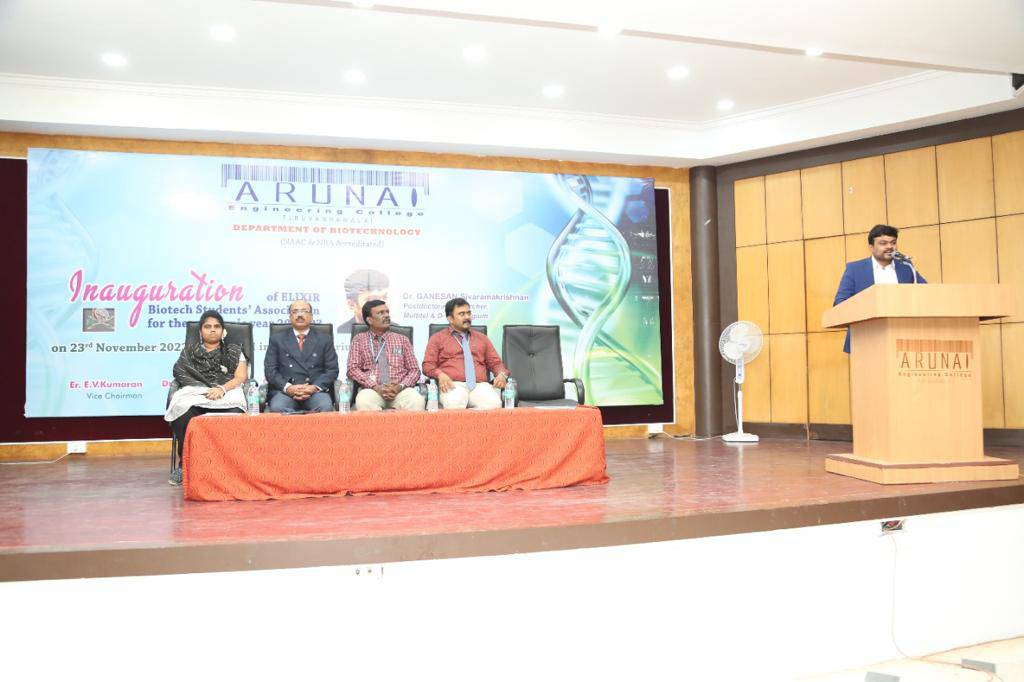
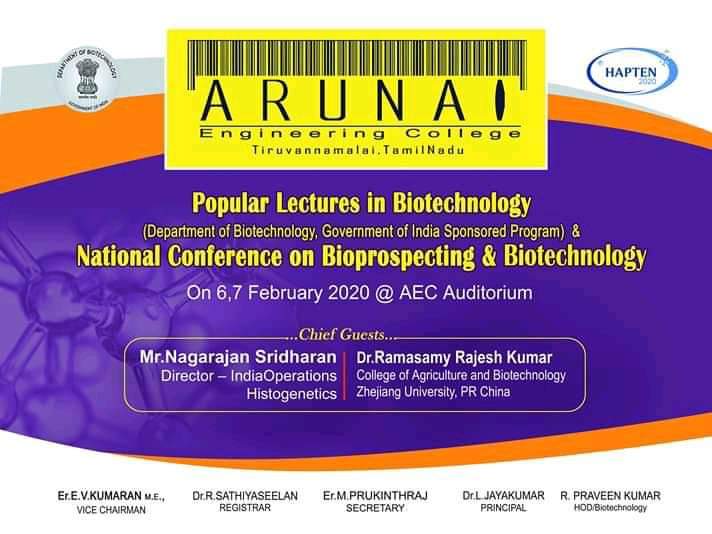
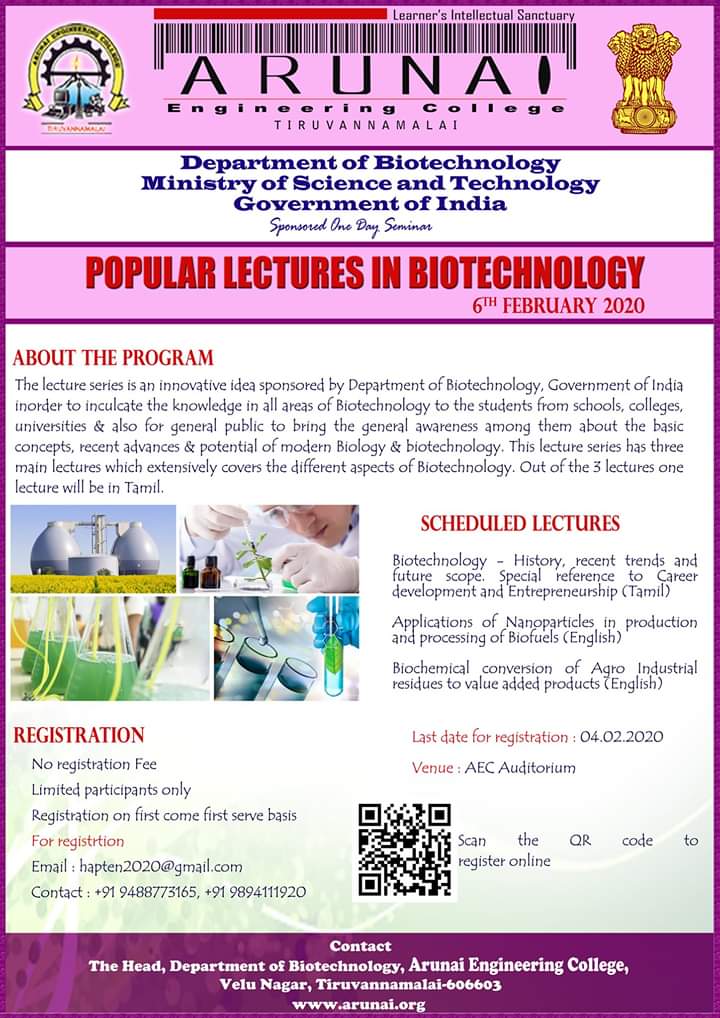
Gallery
Pointers 2K25
Videos
Alumni's Feedback

Nirmal kumar
Post Doctoral Researcher
The college acts as the platform to improve academic skills and also enhace the extracurricular activities.
S. Annamalai
Junior Manager, central R&D, IFFCO group, Dubai
My college molded me into a complete person and enhanced myself.
Ayyappasamy Suddalaiadum Perumal
Post Doctoral Researcher, McGill University, Canada
I learned how to be confident, perserverance and to listen out the details.